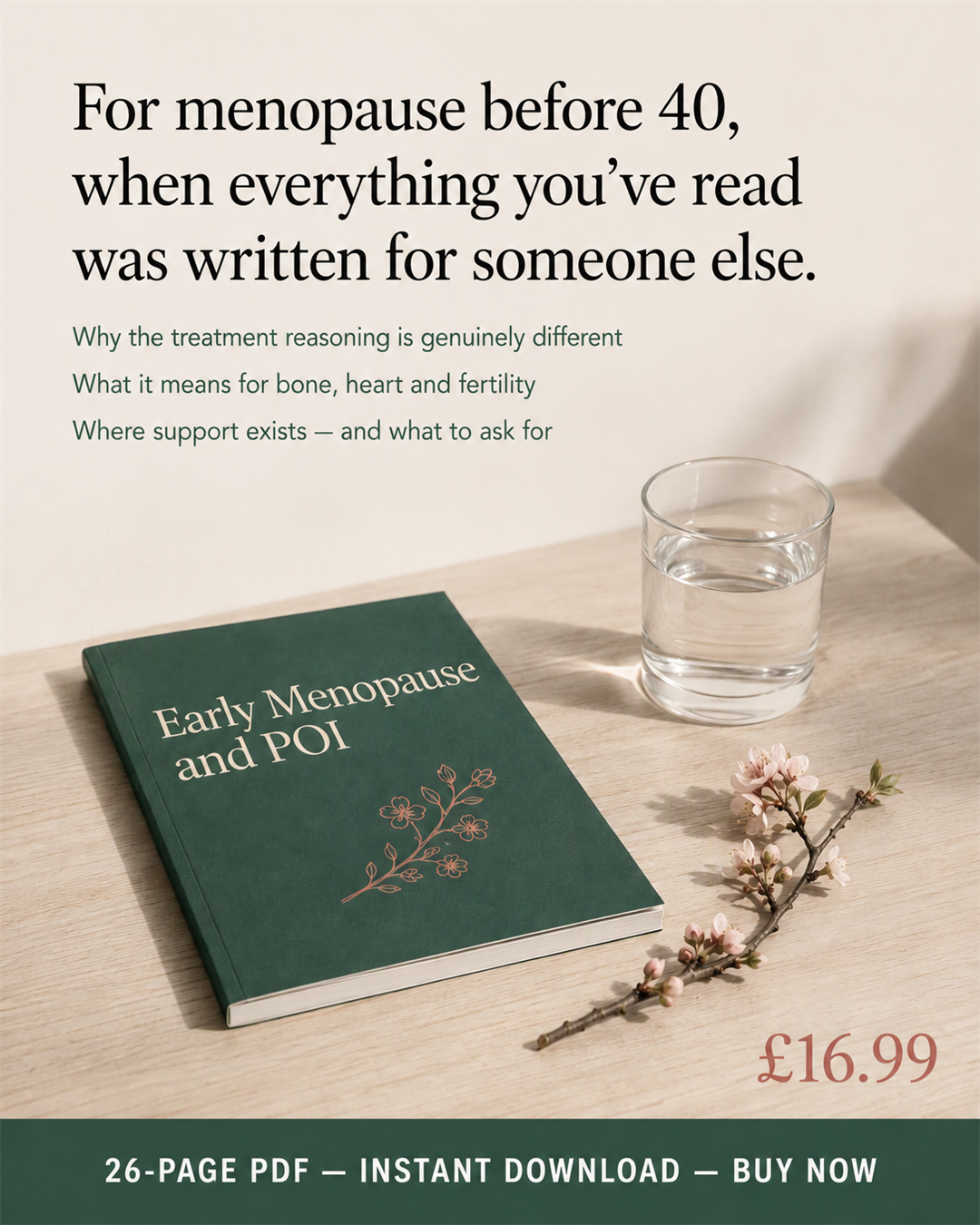
Early Menopause and POI: When It Happens Decades Before It Should
Early Menopause and POI: When It Happens Decades Before It Should
Couldn't load pickup availability
Instant download after checkout · Yours to keep · Read on any device
Almost Everything Written About Menopause Is Written for Someone Else
If your ovaries stopped at thirty-two, or at thirty-eight, very little of the standard advice applies to you in the way it is written, and some of it is actively misleading. The risk figures were calculated for a different population. The advice about whether treatment is worth it assumes a decision you are not making. And nothing addresses being told this at an age when your friends are having babies.
Twenty-six pages, over 7,500 words, written for that situation.
The section that changes everything
The risk figures that dominate public discussion of hormone therapy come from a trial whose participants averaged sixty-three years of age. A woman of thirty-five with premature ovarian insufficiency is in the opposite position: her body should still be producing these hormones for another sixteen years. Applying those figures to her is not caution, it is a category error — and it is part of why only around half of women with POI are receiving hormone therapy at all.
What you will find inside
- What early menopause and POI actually mean — definitions, causes, and why around ninety per cent of cases have no identifiable one
- Getting the diagnosis — the tests that genuinely do apply here, what AMH can and cannot tell you, and why it is so often delayed
- Why the treatment reasoning is different — the most important section in the guide
- Bone — what accelerated loss means at this age, what a DXA result actually says, and what prevents it
- Heart and blood vessels — the long-term picture in real numbers, put honestly in proportion
- Hormone replacement in practice — doses, the two main approaches, the coil, testosterone, side effects and reviews
- Fertility and contraception — what remains possible, what the options are, and the treatments being promoted ahead of their evidence
- The part that is not medical — grief, identity, telling people, and why support belongs at diagnosis rather than months later
- Work, relationships and the long view, plus where to get support
Sourced properly
Written from the British Menopause Society consensus statement on premature ovarian insufficiency, The Daisy Network, NICE NG23, NHS guidance, the HFEA, the Royal Osteoporosis Society and international specialist guidance. Glossary and full source list included.
Format: 26-page printable PDF · instant download · UK & US edition
For education only. Not medical advice. No treatment should be started, stopped or altered on the basis of this guide.